
Govt urged to end super re-contribution loophole


The loophole which has created one of the most commonly-used post-retirement superannuation strategies needs to be closed.
A strong call has been made to the Government to close the door on re-contribution strategies to avoid death benefits.
The call is being made by the Grattan Institute ahead of the Federal Budget as part of its arguments for a general winding back of generous superannuation tax concessions.
The re-contribution strategy is one of the most common utilised by advisers when dealing with clients entering the retirement phase.
“When the beneficiary of a superannuation account dies, any outstanding superannuation balance is paid out as a ‘death benefit’. While most super death benefits paid to dependants are not taxed, benefits paid to non-dependants are often taxed,” the Grattan analysis said.
“But the precise tax payable on death benefits also depends on whether the super fund has already paid taxes on contributions and fund earnings. Only the pre-tax contributions portion of a super bequest is taxable, at 17%. The post-tax contributions portion is tax-free.”
“A common strategy to reduce the taxable portion is to withdraw a lump sum after preservation age (but before the age of 75, when contributions can no longer be made) and re-contribute it as a post-tax contribution.”
“This effectively transforms taxable super into tax-free super, reducing the tax liability on the bequest.”
“This loophole should be closed. A system could be implemented whereby debits are recorded on lump-sum withdrawals commensurate with the taxable share of the withdrawal and are factored into the tax-free component of the ultimate bequest if there are subsequent post-tax contributions.”
“This would be a reform for the long-term: most of those re-contributing are aged between 60 and 69, and so can expect to live on average for about another 20 years,” the Grattan analysis said.
The Grattan paper said “superannuation has become a taxpayer-subsidised inheritance scheme.
“A significant share of superannuation is held in accounts with very large balances that are unlikely to be spent down in retirement. In February this year, the Federal Government announced that from 2025-26, the earnings on balances bigger than $3 million would be taxed at 30% (instead of 15%). This is projected to affect about 80,000 people and trim earnings tax breaks for those with very-high balances by about $2 billion a year once the policy is fully operational,” it said.









The profession, its association, and the industry media really need to stop doing this. The headline frames it as "angst,"…
Govt Theft. Why don’t Pollies & Bureaucrats pay compensation for all their many failure's? Pay up you useless scumbags. PBCS…
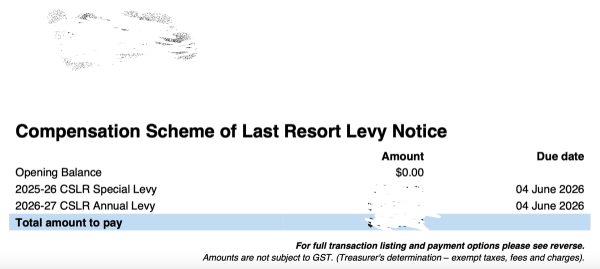
Yes it is true. Received levy and special levy yesterday so I eagerly scheduled the payment. I love covering the…
Any business whose model is centred around bagging the opposition, is a business to be avoided. The fact is, policies…
New business hasn’t fallen enough for you yet? Touch it again and everyone will leave. Risk insurance comprises a small…