
The AFSLs most exposed to the adviser degree qualification gap

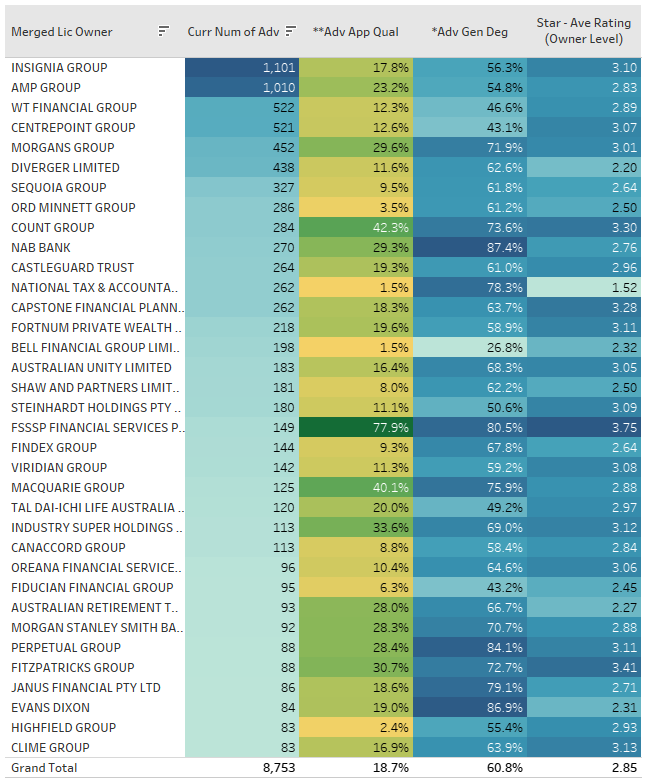
New analysis of financial adviser qualifications has revealed how many advisers face the task of obtaining approved degree-level qualifications before 1 January, 2026, and which licensees are most exposed to as yet under-qualified advisers.
The analysis carried out for Financial Newswire by WealthData also reveals just how important it is for the Government to clear the way for recognition of a wider range of degrees – something which would assist around 40% of practicing advisers.
The WealthData analysis, derived from the Financial Adviser Register (FAR), reveals Aware Super’s FSSSP Financial Services is the best-prepared to deal with the new degree-qualified professional environment with 78% of its advisers having an approved degree qualification, while National Tax and Accountants has just 1.5% with an approved degree.
Importantly, across all licensees with 80 or more financial advisers, 18.7% of those advisers have approved degrees but 60.8% of those advisers have degree qualifications of what sort or another, many of which may ultimately be recognised as relevant for financial advisers.
The WealthData analysis also points to significantly fewer approved degree qualifications being held by people working in the stockbroking space as evidenced by Bell Financial Group with just 1.5% and Ord Minnett with just 3.5%.
However, the arguments of the Stockbrokers and Investment Advisers Association (SIAA) are validated by the data showing that Bell has 26.8% of advisers who possess a degree while Ord Minnett boasts 61.2% with a degree.
SIAA chief executive, Judith Fox, has long argued that stockbrokers have been disadvantaged because their possession of commerce degrees have not been recognised within those approved under the Financial Adviser Standards and Ethics Authority (FASEA) regime.
WealthData principal, Colin Williams said it was not surprising that wealth groups with an accounting background such as Count Group boasted a greater proportion of degree-qualified advisers than those with a background in life/risk advice.
Interestingly, the two largest financial planning licensee groups, Insignia (IOOF) and AMP Group appear reasonably well positioned with respect to the numbers of degree qualified advisers in their ranks.
The analysis shows that Insignia has 17.8% of advisers with FASEA-approved degrees and 56.3% who are degree qualified. By comparison, AMP Group has 23.2% with approved degrees and 54.8% who have a degree.
WealthData and Financial Newswire are both owned by FST Media.












I have an MBA and FARCE don’t (didn’t) recognise the management, controllership, marketing, HR and entrepreneurship subjects.
I also am an Australian Institute of Company Directors (AICD) graduate which FARCE does not recognise.
I have a First Class Honours in Psychology which FARCE does not recognise, yet the Behavioral Finance content in the FARCE exam is based on Psychology.
FASEA is a FARCE!
You are obliviously very intelligent, but why don’t you have any Financial Planning quals? If you have all of these quals that you feel are so closely aligned then surely completing these units would be a walk in the park?
I have similar university degrees to Disillusioned, and I did supplement those with financial planning qualifications via the (real) CFP. Why should I repeat my studies just to line the pockets of conflicted FASEA Board members who crafted the rules to favour their own institutions? Yes it would be easy, but it would be a waste of time and money. And it would be funding corruption.
Unsurprisingly you didnt put your name to such a libellous accusation…
The rules were put in place by the LNP govt and detailed in the legislation, and not by regulation which would’ve been much easier to vary as inconsistencies became apparent. Prior to this legislative requirement coming into being, there was limited demand for financial planning degree options, that has since changed with many providers offering a Fin Planning pathway.
To me, those who automatically think the worst of others have based it on what they themselves would do in any given situation. You think others are motivated by corruptly lining their own pockets because that’s what your default mode of doing business is. I wouldnt want to be one of your clients…
“The rules were put in place by the LNP govt and detailed in the legislation”
You are 100% incorrect. The legislation was very open and gave the conflicted FASEA Board far too much discretion. That’s how we ended up with something so biased, incompetent, corrupt, and far removed from the intent of the original legislation.
Remember all these changes happened after the Hayne RC.
The legislation required that all advisers sit & pass a relevant exam to be able to continue to advise clients.
The legislation required that all new advisers after a certain date be qualified with a relevant degree.
The legislation required that all existing advisers hold a relevant degree or degree-equivalent qualification post 2024, now 2026.
If you look at the AQF a Bachelors Degree is at Level 7. If something is to be degree-equivalent it has to be at AQF 7 or higher.
The question was do you make existing advisers do a full 24 unit Bachelor Degree?? Or do you provide a concession for years of experience and existing quals at a lower rung on the AQF ladder??
When balancing these factors, it was the position of the FASEA board that existing advisers only needed to complete up to 8 units of a Graduate Diploma that sits at AQF8. That removes at least 2/3rds of the subject load for existing advisers.
Seeing that you’re such an expert on what the legislation said, what would’ve been the solution you would’ve implemented to ensure that existing advisers met the requirements to be degree or degree-equivalent qualified??
Jimmy, the reason why everyone hates FARCEA is that, like EVERY other piece of regulation and legislation concocted by a series of inept governments and a keystone cop regulator, was that there was NO CONSULTATION of the professionals that actually do the work. It was concocted by a group of academics, lawyers and left wing commission funded consumer groups.
Common sense will tell you that if you want people involved in a positive way in almost anything you include them in the process and you respect that point of view. This has never happened to date. I have hopes that this has changed with QoA review on now. Bitter experience of past shaftings of advisers tells me tho this is just a smoke screen to get insto employed backpackers giving advice to vertically integrated product floggers. Union and bank alike.
WHY IS VERTICAL INTEGRATION STILL LEGAL????
Everyone hates it, do they? I dont hate it. Most advisers I know dont hate FASEA.
I think the changes that were proposed under the legislation to lift the standards in financial planning were long overdue. One of the main failures in financial planning has been the ability of people to do the barest minimum in education to get registered as an adviser.
The ones who hate FASEA are generally the ones with the lowest quals who think standards should be improved, but just not for them…..
Given that your obviously not an academic, lawyer, or woke left wing tree hugger, what would’ve been your solution to how the changes should’ve been implemented?? I’m guessing there would’ve been no changes that would’ve impacted you…
You’re correct, none of the changes DID impact me as I already met the qualification standards before they changed. Just had to complete the ethics course and exam only like every other licensed person.
I am 100% behind professionalism and a strict code of conduct but if you think the current version is fit for purpose you (and your adviser mates) actually don’t understand its implications.
As I’ve been saying on blogs for years now, remove FASEA and ASIC from advice, professional standards board with individual licensing, a code of conduct written by professionals within the industry, regulate, mediate, remediate with teeth. Simples.
The following stockbroking firms are well positioned with existing degrees, with high percentages of degree-qualified advisers:
Many other stockbrokers have degrees that are not recognised in any way. Those with a resources analyst background will have a science or engineering degree. Those who have analysed health stocks will have a medical degree.
This is junk analysis. ASIC registers do not currently capture all the degrees of an adviser and the FASEA status of those degrees. This is due to database design flaws, FASEA rule subtleties, and the voluntary nature of recording adviser education details on ASIC registers. When the underlying data is incomplete and inaccurate it doesn’t matter how much computing power you throw at it, the resulting analysis will always be junk.
The table doesn’t really tell a full story. You could have a relevant degree, and maybe and Advanced Dip, and then only need to do 1 bridging subject. So without a full analysis, which unfortunately doesn’t exist anywhere, you cant get a good picture of what is going on.