
Three-quarters of active managers underperformed

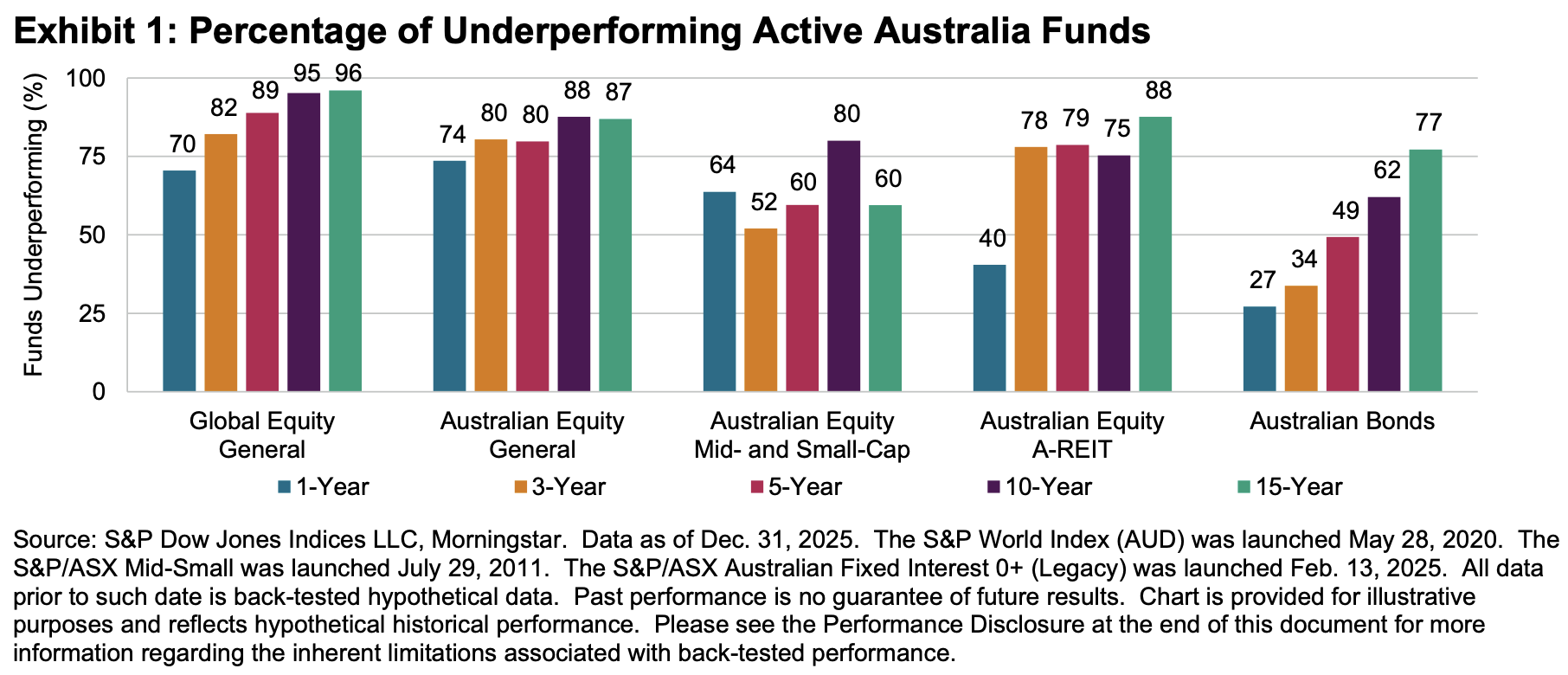
In what represents further confirmation of the challenges facing active investment managers, the latest S&P Dow Jones Indices SPIVA Australia Year-end 2025 Scorecard has confirmed that three-quarters of actively managed funds underperformed.
The S&P analysis said this underperformance was despite a generally favourable environment for stock selection.
“In the Global Equity General category – the category with the largest number of funds -70% of funds underperformed the assigned benchmark, only slightly better than the historical average of 73%,” it said.
“Australian Equity General and Australian Mid- and Small-Cap funds fared worse than their historical averages, with underperformance rates of 74% and 64%, respectively. Not surprisingly, Australian Equity A- REIT funds performed notably better, with an underperformance rate of just 40%, the lowest since 2013.”
It said the Australian Bonds category remained the brightest spot, with 73% of funds surpassing their assigned benchmark, noting that examining traditional sources of active returns (credit and term factors) helps explain the broad-based outperformance.
“The strong majority outperformance of Australian Bonds funds in 2025 suggests that many managers either lowered term risk or increased credit risk relative to the benchmark,” it said.
Commenting on the results, S&P DJI’s Head of Index Investment Strategy, Sue Lee said Australian active managers experienced mixed fortunes in 2025.
“Many active equity funds, both domestic and global, struggled to match the market performance. In contrast, active A-REIT funds delivered a majority outperformance, marking their best relative results since 2013,” she said.
“Active bond funds had the lowest rate of underperformance among all categories, extending their streak of majority outperformance to a third consecutive year. Despite these successes, a firm majority of funds in every category underperformed over the decade ending in December 2025.”
- – Global Equity General Funds: Despite relatively resilient results in the first half of 2025,1 active funds lost ground in the second half and recorded a 70% full-year underperformance rate. These funds had an asset-weighted average return of 9.6%, versus the 13.3% gain in the S&P World Index (AUD). Underperformance rates increased for longer horizons, exceeding 95% over the 10- and 15-year periods.
- – Australian Equity General Funds: The S&P/ASX 200 rose 10.3% in 2025, marking its third consecutive year of double-digit growth, while actively managed Australian Equity General funds returned 7.5% on an asset-weighted basis. The underperformance rate was 74%, compared with its long-term average of 60% (see Exhibit 7). Over 15 years, 87% of funds failed to beat the benchmark.
- – Australian Equity Mid- and Small-Cap Funds: The S&P/ASX Mid-Small surged 21.5% in 2025, raising the hurdle for active funds. Nearly two-thirds (64%) of Australian Equity Mid- and Small-Cap funds underperformed, with an asset-weighted average return of 13.2%. Funds in this category exhibited comparatively stronger results over the long term, with 60% lagging the benchmark over the 15-year period.
- – Australian Equity A-REIT Funds: While the S&P/ASX 200 A-REIT posted a healthy 9.2% gain, Australian Equity A-REIT funds delivered an asset-weighted average return of 11.7%, with 40% of funds underperforming—the lowest level since 2013. Over the 15-year period, however, 88% of funds underperformed.
- – Australian Bonds Funds: Active bond funds’ relative performance improved in H2 2025 as credit spreads resumed tightening. The full-year underperformance rate was 27%, versus 46% in H1 2025, extending their low underperformance rates observed in 2024 (30%) and 2023 (26%). Funds returned 4.0% on an asset-weighted average basis, compared with 3.2% for the S&P/ASX iBoxx Australian Fixed Interest 0+ Index.
– Fund Survivorship: Liquidation rates remained moderate, averaging 4% across categories in 2025 (see Report 2). Australian Equity A-REIT funds again showed the highest liquidation rate at 7%, following 18% in 2024.2 Conversely, Australian Equity Mid- and Small-Cap funds recorded the highest survival rate of 97%. Attrition increased materially over longer time horizons, with 52% of funds across all categories merged or liquidated over the 15-year period.









Compare the pair. Stephen Jones promised the world and delivered nothing. Daniel Mulino is promising the world and delivering nothing.…
I agree. It has been quite difficult to work out what to do as a AFSL. Between OAIC & Austrac…
Yet Jane Hume thinks the Finfluencers are wonderful. What an Adviser killer disaster she has been and continues to be.…
Any BA hey ?? What a dumb idea ? Cut the red tape and like shorter SOA ‘s that get…
A BA in zoology will not assist the public. Where is the red tape relief ? Anyone with a functioning…