
CSLR reform common denominator: Dump AFCA’s ‘but for’


If the Assistant Treasurer and Minister for Financial Services, Daniel Mulino, acts in accordance with the vast majority of submissions received relating to the Compensation Scheme of Last Resort (CSLR) then, in future, compensation will be based on actual capital losses.
A reading of all the publicly-available submissions to the current Treasury consultation around the CSLR confirms that almost every significant stakeholder believes the Australian Financial Complaints Authority (AFCA) has erred substantially in applying its so-called ‘but for’ methodology.
Some submissions are even arguing that the CSLR should be empowered to recalculate AFCA’s ‘but for’ approach.
Even the CSLR itself has been opposed to the ‘but for’ approach, something made clear to Financial Newswire’s recent Advice, Wealth and Super conference by CSLR chief executive, David Berry.
While required to handle AFCA compensation determinations in their current form, the CSLR has provided a formal submission to Treasury arguing that, irrespective of legal interpretations, the AFCA approach is unsustainable
The CSLR included the following table in its submission to Treasury’s Post-implementation review of the CSLR.
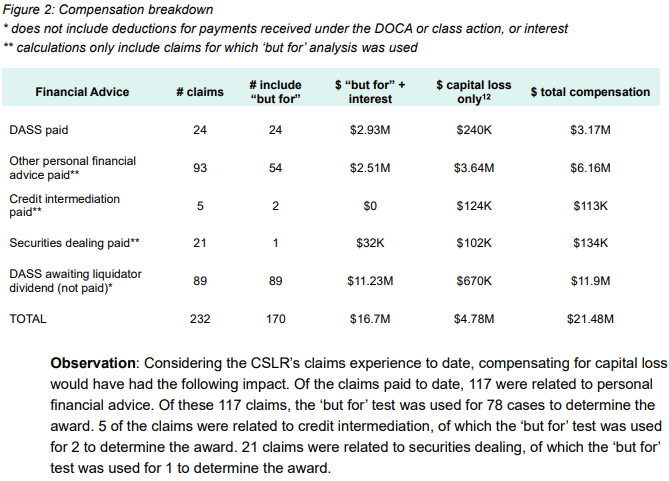
The table clearly shows the additional burden the “but for” approach has imposed on the scheme.
According to Financial Newswire’s audit of publicly-available submissions, the following organisations have urged the dumping of the ‘but for’ approach:
The Financial Advice Association of Australia
The Stockbrokers and Investments Advisers Association
CPA Australia
CA-ANZ
Institute of Public Accountants
Financial Services Council
The Financial Services Council (FSC) is arguing that the CSLR regulations should be updated to require the CSLR operator to calculate compensation on a net loss basis, taking into account all relevant recoveries connected to an AFCA determination.
It also recommends that that “the CSLR compensation framework should be amended to adopt a capital loss-only methodology, replacing the current counterfactual approach”.
“This reform should be prioritised as one of the most effective means of achieving scheme sustainability and ensuring it operates as a genuine last resort”.
For its part, the FAAA said it strongly supports a change to the in the approach to counterfactual loss (the ‘But-For’ test) “as we believe that a scheme of last resort should seek to compensate for lost capital and not lost earnings”.
“A scheme of last resort should seek to provide capped and limited compensation, prioritising restoring consumers’ capital as quickly and widely as possible. It is not consistent with a scheme of last resort to be providing guaranteed positive returns that are funded by innocent parties.
“We understand from the scheme operator that approximately 80% of claims paid to Dixon Advisory clients so far has been in respect of counterfactual loss – making additional payments to consumers who were in many cases wealthy and had in fact achieved positive returns across their portfolios . “This approach makes sense where those funding the compensation are those who gave the flawed advice. It is not appropriate when those funding the compensation had nothing to do with the consumers’ losses,”
The major accounting groups used a joint submission to state that they support “limiting CSLR compensation to capital losses only” noting that “It is generally understood that a competitive investment market requires that, outside of fraud or theft, investment risk should for the most part be borne by investors”.
“And while investment performance can be – and often is – benchmarked to neutral indicators such as indices, interest rates and inflation rates by advisers, financial product manufacturers and regulators alike to objectively gauge performance, the CSLR is intended to reside at the bottom end of the recovery stream and requires multiple failures to take place before it comes into effect,” they said.










And every input (except the FSC) wants MIS as front line CSLR levy payers. Plus: MISPlatforms Research Responsible Entities Super…
100% agree with this. "But for" demonstrates a complete lack of understanding of capital investing. Until now it has been…
More rubbish out of Canberra funded by taxpayers. Another public institution that should not be considered as trusted. Disgusting.
Dixon MIS fiasco was back dated into CSLR as there were many Canberra bureaucrats caught. Nothing like self interest to…
Looks like there are some cultural issues within Treasury if they want to play smoke and mirrors. Probably explains the…