
Govt proposes advisers can self-assess into experience pathway


The Federal Treasury has put meat on the bones of the financial adviser experience pathway with a consultation paper which makes clear that it will be available to 1 January, 2026, and will entail advisers self-assessing via their licensee to access the regime.
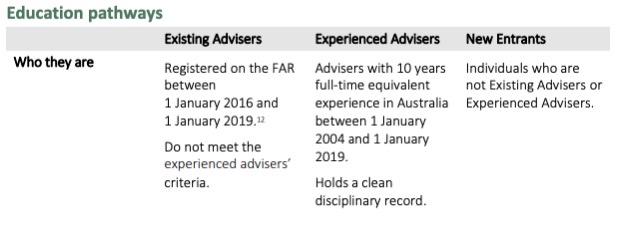
The Treasury consultation paper makes clear that experienced advisers will need to have 10 years full-time equivalent experience in Australia between 1 January 2004 and 1 January 2019 and hold a clean disciplinary record.
Importantly, it suggests the 10 years will not have to be consecutive and that the “ten years of full-time equivalent experience out of a 15-year window allows consideration for time out of the industry and part-time work”.
“Importantly, the period between 1 January 2004 and 1 January 2019 covers significant historical events, such as the global financial crisis, ensuring eligible experienced advisers have lived experience in volatile economic conditions. Additionally, this ensures that the 10 years’ experience is relatively contemporary,” it said.
“It is proposed that individuals seeking to access the experienced pathway will self-assess their eligibility through their licensee, taking into account the prescribed criteria and additional guidance that would be provided,” it said.
“If an adviser considers that they have met the eligibility criteria, they will be required to self-declare on an application to access the pathway.”
“It is not proposed that ASIC will assess applications to determine an adviser’s eligibility. Instead, it is proposed that ASIC will audit a sample of applications for compliance with the eligibility criteria. This will not prevent ASIC from deciding to scrutinise a specific application from an adviser where ASIC is aware that an adviser may be ineligible. For example, if the adviser has had disciplinary actions recorded against them on the FAR.”
Elsewhere in the discussion paper, Treasury has proposed a streamlining the core knowledge areas of approved degrees from the current 11 to five comprised of Taxation law, Commercial law, Financial advice regulatory and legal obligations, Ethics and Professionalism and Behavioural finance and client engagement.
It stated: “The streamlining of the core knowledge areas ensures that all financial advisers share a common foundation of knowledge and learning outcomes that will be applicable in a range of financial service industry roles. This is not to say that those core knowledge areas that have been removed are not relevant to the financial advice profession, rather this emphasises that not all core knowledge areas will be relevant for every financial adviser, and it may be more appropriate for potential financial advisers to choose those knowledge areas as electives or to develop those core knowledge areas ‘on the-job’ during their professional year. We expect that the core knowledge areas and learning outcomes would for the most part mirror the existing learning outcomes”.










The CLSR is blatant robbery from small business owners( Financial Planners) that have nothing to do with them or their…
How do the Dixon powers to be sleep at night. Burn the company to the ground for us to pick…
Just the stupid ones remaining.
CSLR means Compensation Scheme of LAST Resort, not First Resort. If there is no fraud involved in Dixon's, Shield and…
Just for clarity, the Government has recently proposed that any special levy would be broadly spread across retail facing sectors.…