
How Treasury kept MISs out of CSLR funding

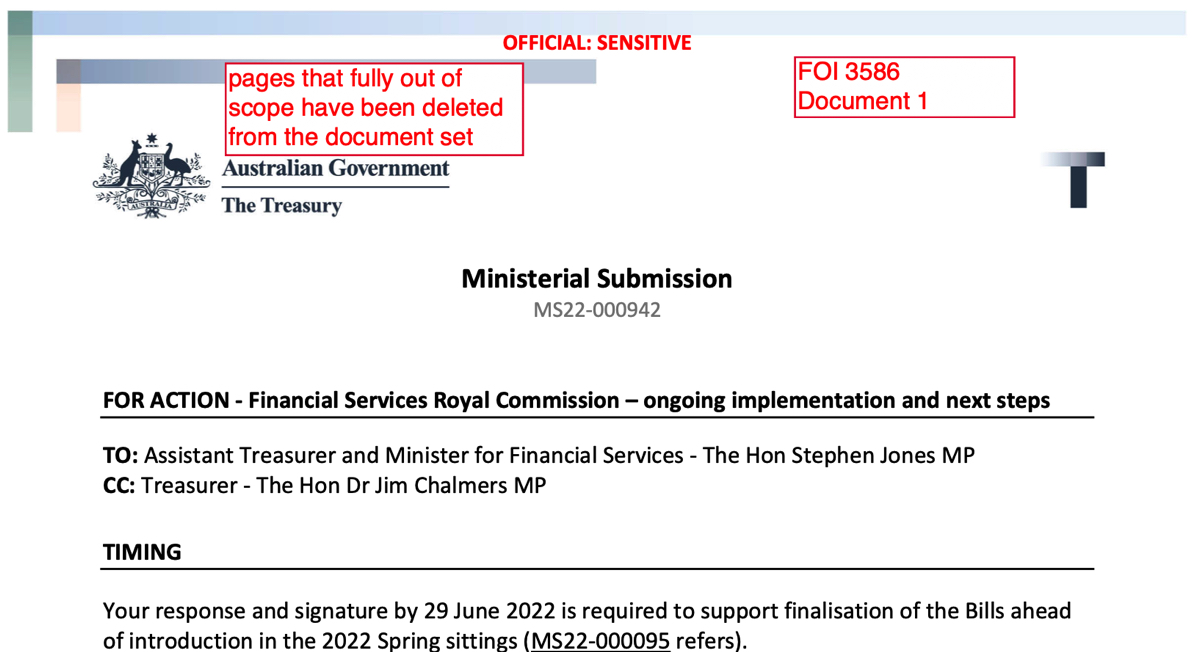
Cost to the public purse appears to have sat at the core of Treasury in 2022 recommending to newly-minted Assistant Treasurer and Minister for Financial Services, Stephen Jones, that Managed Investment Schemes (MISs) be left out of funding the Compensation Scheme of Last Resort (CSLR).
Further, the review of the regulatory settings of Managed Investments Schemes which has only recently been completed was advanced by Treasury as an alternative to including MISs in the CSLR funding equation.
This is revealed in a Ministerial Submission from Treasury obtained under Freedom of Information which recommended to Jones that “you agree to finalise the response of the Financial Services Royal Commission by Tasking Treasury to review the regulatory framework of Managed Investment Schemes, subject to a further brief on the scope, timing and nature of such a review, including resourcing required.
The heavily redacted FOI documentation made the recommendation despite acknowledging “Failures of Managed Investment Schemes (MISs) have and will continue to be a significant category of unpaid claims”.
But it then went on to state: “However, including MISs in the CSLR raises risks and broader design issues, and would not address broader issues regarding the regulatory framework for MISs.
“Accordingly, we recommend against including MISs within scope of the CSLR at this time and instead undertaking a review of the regulatory regime applying to MISs with a view to testing options to strengthen investor protections.”
The Treasury document includes an attachment giving the department’s reasoning and leaving no doubt that it was worried about the costs which would flow as a result of their inclusion, including doubling the monetary impost which was about to be imposed on the top-10 financial firms to pay for the set up.
“As at 1 June 2022, the Australian Financial Complaints Authority (AFCA) had 334 complaints which relate to failed MISs. The total value of these complaints is estimated to be $34.5 million. If the scope of the CSLR was extended to include MISs (with a claims cap of $150,000), the expected compensation payments and associated AFCA fees for these complaints would be $29.0 million, and this amount (and ongoing claims) would need to be funded by the MIS sector and potentially other financial institutions.
– The current design of the CSLR includes a levy on the top-10 financial firms to pay compensation costs and associated AFCA fees for unpaid claims accumulated between 1 November 2018 and the date the legislation is introduced. Including MISs would increase the costs to be funded by the top-10 firms from $35.6 million to $66.7 million.
– We also expect that including MISs within scope of the scheme will result in more MIS- related complaints being lodged with AFCA, further increasing the costs for the scheme.
The Treasury document makes it clear the department had a heavy preference for following the recommendations of the Ramsay Review noting “In recommending that the CSLR initially be restricted to financial advice failures, the Ramsay Review noted that the inclusion of such failures within the CSLR was appropriate given the significant regulatory reform that had improved the quality of advice concerning more complex products”.
“The subsectors proposed to be within scope of the CSLR (personal financial advice, credit provision, credit intermediation and securities dealing) have been subject to a number of reforms over the past decade which have significantly reduced the risk of misconduct and failure. In our view, there is a need to review the regulatory framework applying to MISs before the same can be said for the adequacy of regulatory settings for MISs.
- For example, the UK banned issuers and distributors from marketing fund products with similar features to high risk MISs to retail investors from 2020.
- In Australia, the design and distribution obligations (DDOs), which commenced on October 2021, was a key reform affecting the distribution of MISs. DDO requires MIS issuers to design products to meet the needs of investors and to distribute the products in a more targeted manner. If the DDO regime works as expected, high risk MISs should not be offered to retail investors. However, it is still too early to assess whether DDO is sufficient.










YES! you idiots. Of course it should. Then can we sue the government for forcing the closure of small /…
Mike Taylor, you're a good man. Can you tell us what the point of our comments is, if they go…
Redacted to protect Corrupt Canberra
Canberra & Dixon's MIS fiasco is Corrupt as hell. PS - thanks for re-using my Govt / Dixons dot pts…
The mistake the Finfluencers make is being licensed in the first place. Just join the legions of accountants, property spruikers…