
Private markets going increasingly retail

Notwithstanding the concerns of regulators, new private markets research has pointed to a rapid expansion of retail participation in the sector.
The fifth and latest State Street Global Private Markets Survey Report, released today, has found that, globally, more than 80% of asset and wealth managers are already offering, or intending to offer, private market solutions to individual investors and the trend has not missed the Asia Pacific.
According to the State Street report, 85% of respondents in the Asia Pacific are offering or planning to offer retail vehicles with almost six in 10 institutions in the region expecting that at least half of fundraising to come from retail-focused strategies within three years.
Commenting on the findings, State Street senior managing director for Global Alternatives, Eric Chng said it study showed that not only are asset and wealth managers targeting a new client base, but asset owners, including pension funds and insurance companies, are also planning to make use of these new structures for tactical asset allocation and faster deployment of assets.
Speaking to Financial Newswire, Chng acknowledged the concerns expressed by regulators about valuations, but said the study indicated the private markets industry is undergoing a structural shift within which retail is becoming a core component of growth.
He said that although there had been a lot of headlines around private markets in the last year, the investors polled by State Street had a long term view of private markets around diversification and alpha.
In summary, I’d say private market allocations are proving resilient and investors are pretty patient and steadfast in their allocations and that will continue to be the case.
Chng said however that as access to private markets broadens, firms are facing increasing operational complexity, particularly around liquidity management, data transparency and regulatory compliance.
The State Street analysis noted that nearly eight in 10 respondents to the global survey had cited liquidity management as a key challenge, alongside rising demands in areas such as compliance, reporting and investor servicing as firms scale to meet a more diverse client base.
“High levels of dry powder, slow exit activity, and distribution dynamics are sharpening private managers’ focus on cash flow forecasting and liquidity optionality,” Chng said. “Investors are seeking deeper look-through, clearer fee and expense visibility, and stronger valuation governance, supported by connected workflows rather than spreadsheets and email trails.”
“The private markets industry is consolidating. Scale, track record, and operational maturity are key differentiators in capturing a growing share of capital.”
Referencing the challenging backdrop created by conflict in the Middle East, the State Street analysis said demand for illiquid assets remained notably resilient.
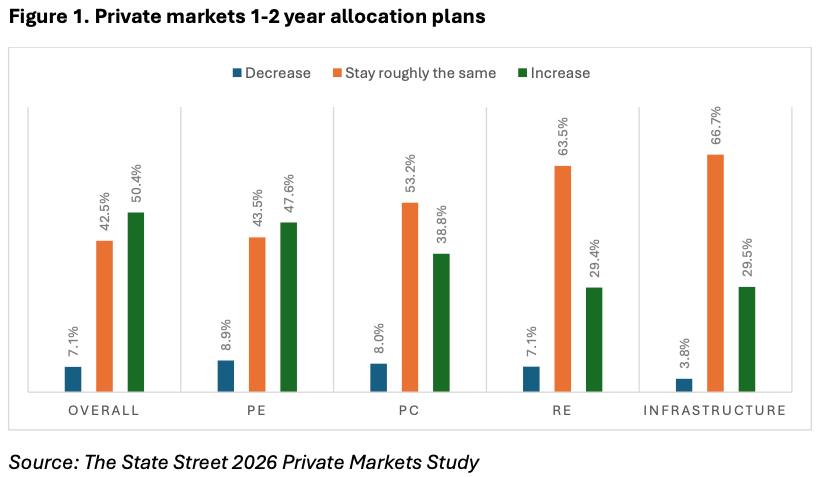
“Just 7 percent of asset owners plan to reduce their exposure to private markets over the next two years, while exactly half intend to grow their allocations. The remaining 43 percent expect to maintain current levels,” it said.
The analysis said approaches vary by sub-asset class (see Figure 1 below). Private equity (PE) remains the most favoured strategy, with 48 per cent of respondents planning increases, followed by private credit (PC) (39 per cent), and both infrastructure and real estate (RE) (both at 29 per cent).
PE was however marginally more likely to see reduced allocations (9 percent), compared to 8 percent for PC, 7 percent for RE, and just 4 percent for infrastructure.









My Dear Comrades....I don't think the Public Servants in the Department of Red Tape really care about "challenges".
Gender Super Gap is rather pointless as a measure of inequity when it only considers one part of a persons…
The problem with the left is not just their identity politics, but that they think the government must provide everything…
Arrogant Snake Chalmers
No comments from ASIC on asset valuations for unlisted assets held in the union funds? What a surprise. Can ASIC…