
FSC modelling reinforces negative CGT impacts

The Financial Services Council (FSC) has moved to take the fight up to the Government over its Budget changes, producing modelling showing how much worse off investors will be.
The FSC said its modelling indicates that the impact of the Capital Gains Tax changes will increase the effective tax rate on long-term investments in shares, exchange traded funds (ETFs) and managed funds, where long-run investment returns materially exceed inflation.
It said its analysis demonstrates that the changes could materially increase taxes on Australians investing outside superannuation, including younger Australians, families, part-time workers approaching retirement.
The FSC said its modelling also suggests that Australia’s international competitiveness could be undermined by materially increasing the effect CGT rate relative to other OECD economies.
“Under the current system, Australia has the sixth lowest effective CGT rate in the OECD for a median 25-34 year-old investing $10,000 in shares over 10 years. Under the proposed framework, Australia would fall to 24th lowest.
“The changes shift Australia from having one of the more internationally competitive CGT regimes, to the lower half of the OECD rankings,” the FSC said.
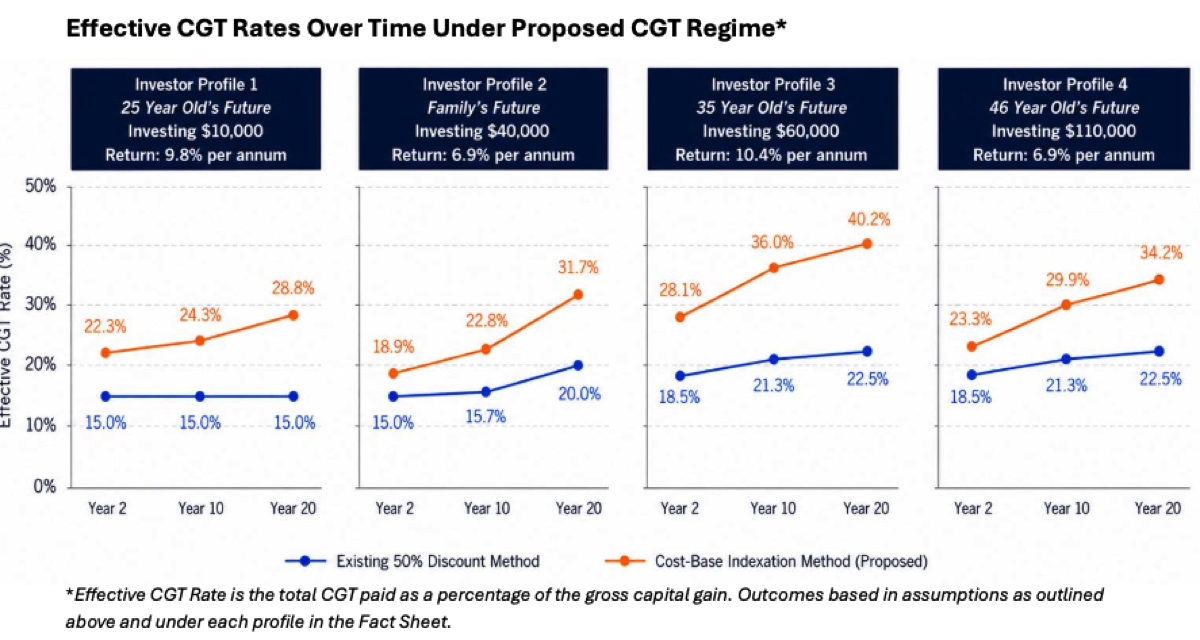
An investor profile analysis developed out of the FSC modelling found the following:
A 25-year-old Australian on the median income investing $10,000 in Australian shares would pay an additional $151 in tax after 2 years, $1,443 after 10 years and $7,552 after 20 years under the proposed framework. Over that period, the effective CGT rate would rise from 15 per cent under the current 50 per cent discount to 28.8 per cent under the proposed cost-base indexation model.
- A median-income young family investing $40,000 in a balanced managed fund would pay an additional $13,106 in tax after 20 years, with the effective CGT rate increasing from 22.5 per cent to 31.7 per cent.
- A 35-year-old professional on an above-median income investing $60,000 in a high- growth managed fund would pay an additional $66,045 in tax after 20 years, with the effective CGT rate rising from 22.5 per cent to 40.2 per cent.
- A 46-year-old operations manager on an above-median income investing $110,000 to build financial security would pay an additional $36,042 in tax after 20 years under the proposed framework, with the effective CGT rate increasing from 22.5 per cent to 34.2 per cent.
It said wo ‘Investor Profiles’ also demonstrate the impact of the proposed 30 per cent minimum tax on capital gains on Australians who are in lower income brackets, including students, part-time workers, carers and Australians easing into retirement. The new minimum tax will override the normal operation of lower marginal tax brackets by imposing a 30 per cent floor on investment gains.
For people on low incomes, FSC’s modelling shows:
- After just two years, a 19-year-old student working part-time and investing $15,000 in a diversified ETF portfolio, would see their effective CGT rate almost triple – rising from 7 per cent under the current 50 per cent discount to 19.1 per cent under the proposed cost-base indexation method.
- A 53-year-old who has involuntarily reduced their hours to part-time work, due to a redundancy ahead of retirement, would see the tax payable on a $15,000 real capital gain increase from $1,050 to $4,500 solely because of the proposed minimum tax floor.
“The ‘Investor Profiles’ modelled in this analysis assume investments generate meaningful real capital growth over time, consistent with long-term historical returns for the asset classes examined,” it said







You lost me at SMC. Urghhh.
Nothing unexpected -this is what you get when the voices that matter most are a preferred circle of trustees linked…
Lies, lies & more lies from Albo’s government. The same bloke who promised to run the most open & transparent…
They promised no changes. They changed everything. Classic Lying Labor. Your property and share portfolios are now officially invited to…
I’m loving the fifth paragraph here regarding litigation.