
IMAP webinar identifies growing US/Aust divergence


Australian investment managers are not as sanguine about energy-driven inflation pressures as their US counterparts and cannot afford to be, according to the recent Institute of Managed Accounts Professionals (IMAP) fixed income webinar.
The webinar developed a central theme – that inflationary pressures, driven in large part by rising energy costs, are proving more persistent than markets had hoped and that the challenge for Australian investment managers is the complexity of other factors feeding into the dynamic.
The webinar brought together Van Eck’s Cameron McCormick and Bentham Asset Management’s chief investment officer, Richard Quinn and was moderated by JANA Investment Advisers’ Robert Moore.
Drawing on observations from a recent global research trip conducted as geopolitical tensions escalated, Moore noted that markets initially viewed the latest energy-driven inflation shock as transitory, though investors are increasingly reassessing how persistent inflation may prove – particularly in regions already grappling with structural inflation pressures. A “Higher for Longer” Reality
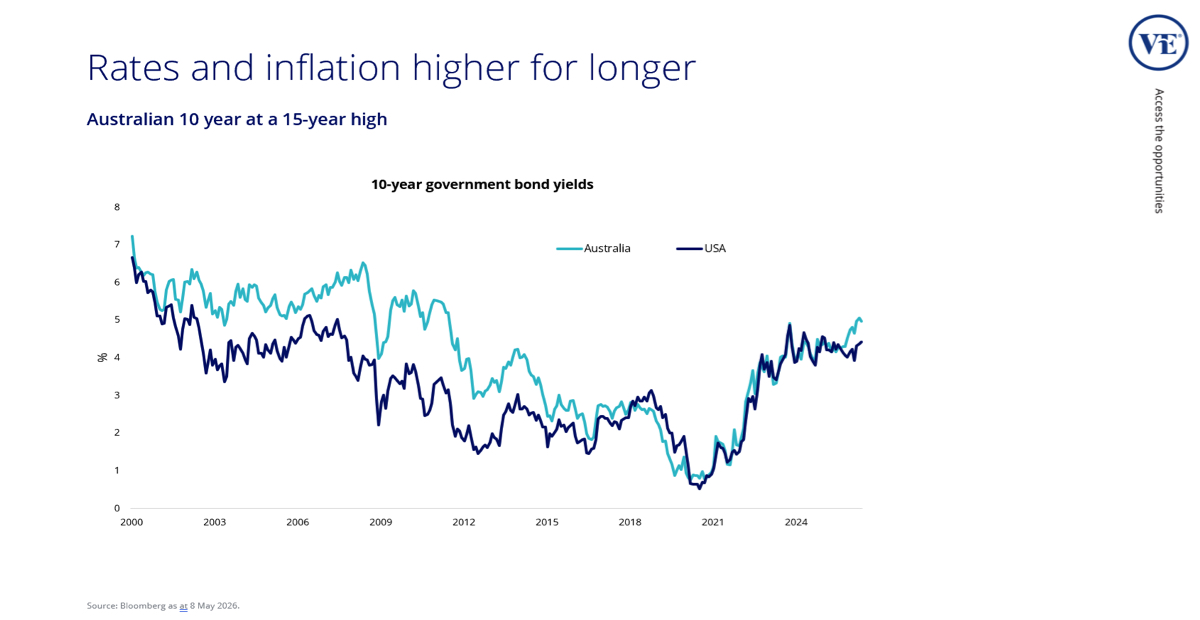
The central theme of the session was clear: inflationary pressures, driven in large part by rising energy costs, are proving more persistent than markets had hoped. McCormick noted that US headline inflation has climbed to 3.8%, with oil prices a key driver, and outlined a base case in which inflation exceeds 4% and remains elevated for several years. The Australian picture is starker still, with the 10-year bond yield now sitting at 5.1% — its highest level since 2011 — and services inflation in categories such as education and housing running above 5%.
Quin offered important historical context, drawing a contrast with the post-COVID rate cycle. Unlike February 2022, when central banks were lifting off from near-zero with inflation already running at 7%, today’s starting point is materially different — rates are already at restrictive levels and central banks have more room to assess the data before acting. Nevertheless, he acknowledged that another one or two rate hikes in Australia remains the market’s base case, with the RBA facing a stubbornly tight labour market and persistent services inflation.
Australia vs the US: A Diverging Outlook
A recurring theme was the growing divergence between Australia’s policy outlook and that of the United States. Where US managers largely view higher energy costs as a transitory tax on growth — and have all but priced out rate cuts without yet pricing in hikes — Australia’s central bank faces a more complex task. Consumer confidence has fallen to multi-year lows, rising petrol and diesel prices are acting as a de facto rate rise for households in the mortgage belt, and the federal budget’s housing policy changes have added further uncertainty.
Quin made the case that Australia nonetheless represents the “cleanest dirty shirt”: relatively conservative fiscal settings, a central bank governor with clear anti-inflation credentials, and a currency that serves as a natural shock absorber in a commodity-driven environment. McCormick echoed the relative value argument, noting that Australian credit spreads, while tight, have not compressed to the same degree as US spreads, suggesting there may be more to work with domestically.
The Case for Fixed Income
McCormick pointed to the oil futures curve as the key variable to watch: a flattening in that curve (away from steep backwardation) signals that markets now expect elevated prices to persist, which will flow through to inflation expectations and ultimately to central bank decisions. Corporate earnings — particularly in the US, where Q1 results beat expectations at an above-average rate — continue to underpin credit markets, though both speakers flagged risks in the high-yield space and cautioned that the heavy capital spending by hyperscalers on AI infrastructure warrants close monitoring.
Despite the uncertainty, both speakers made a clear case for the value now available in fixed income. Quin was direct: a 5% yield on government-backed bonds is a compelling starting point that investors would have “killed for” during the COVID era when the Australian 10-year yielded 0.63%. With risky assets — both equities and credit — looking priced to perfection, he argued that mainstream fixed income is well-placed to provide genuine portfolio protection if growth disappoints.








Imagine if we had "Bank Aligned Adviser" But apparently this is different...... I wonder if they take the IFS Trusted…
So is this a different animal to "Qualified Adviser" ? Did we ever find out who thought of the name…
How about we given them a correct designation as GDJ (Glorified Desk Jockey)
So! Who makes the decision on a “trusted” adviser ? What qualifications do you need? Why mother about obtaining a…
How do you become a IFS Trusted Adviser? integrated selling???