
Portfolio Management: Looking Through the Advice Lens

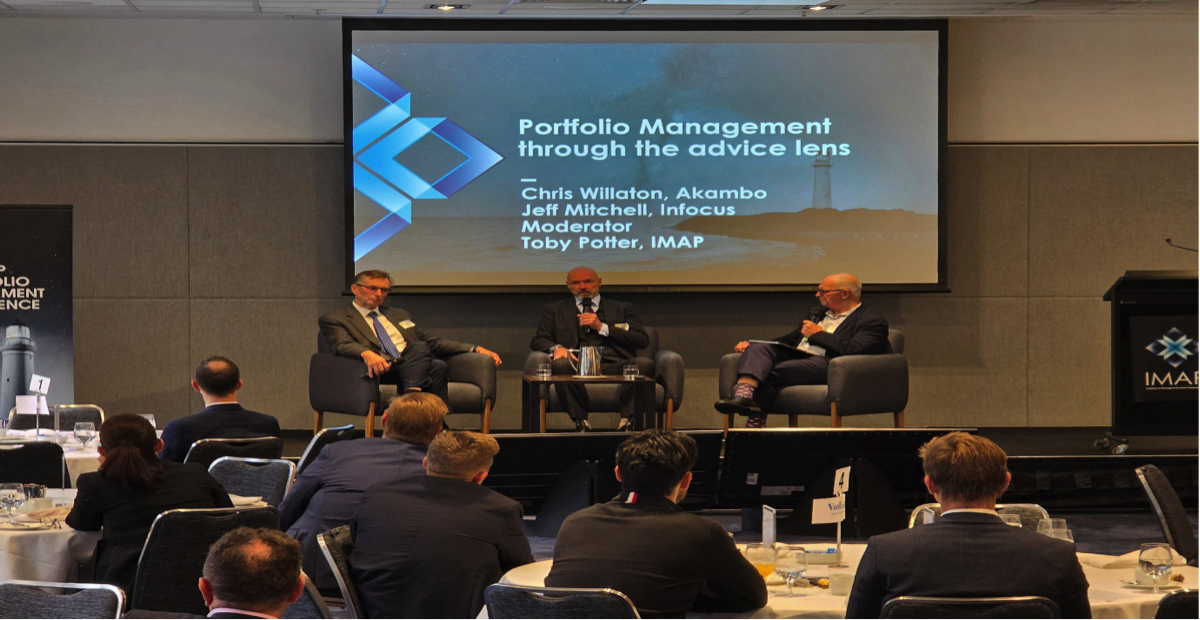
There are good reasons why major licensees build managed accounts into their offering – something made clear by Infous CIO Jeff Mitchell and Akambo CIO, Chris Willaton.
Speaking at the IMAP Portfolio Management Conference in Melbourne, Mitchell and Willaton offered a practitioner’s perspective on building and managing a portfolio management capability within an advice business.
Both Infocus and Akambo exemplify businesses where portfolio management has grown organically out of an advice heritage. Infocus operates as an end-to-end integrated wealth business with advice, platform and investment management capability. Its investment management arm, Alpha Investment Management, runs managed accounts and managed funds across six platforms, serving clients from the mass market through to high-net-worth individuals. Akambo, founded by advisers, is a dedicated wealth management business that designs, manages, and governs investment portfolios — primarily through managed accounts including SMAs and MDAs — now supported by its affiliated consulting partner, Vertex Investment Services.
Scale and Resourcing
For Jeff, scale is a foundational requirement for any portfolio management business. Alpha’s team of seven professionals, including an external asset consultant, runs a highly quantitative process, selecting underlying securities directly rather than investing in funds of funds. He emphasises that having the right data is non-negotiable: without it, performance suffers. Resourcing, he argues, must include not just the right people but also the right technology — and critically, the capacity to pivot when something unexpected emerges.
Akambo’s investment team of 15 — including 10 portfolio managers averaging over 30 years of industry experience — takes a similarly rigorous, institutional-grade approach. Around nine months ago, Akambo identified artificial intelligence as a significant opportunity, investing heavily to integrate tools such as Claude to streamline processes, strengthen risk management systems, and improve data interrogation. Chris says the impact has been equivalent to adding several new investment managers to the team, propelling the business forward considerably.
The Growth of Managed Accounts and Regulatory Scrutiny
Both Jeff and Chris agree that managed accounts have reached critical mass, becoming mainstream for advisers serving mass affluent retail clients over the past three years. As at 31 December 2025, IMAP reported funds under management in managed accounts totalling $292.9 billion. While SMAs have driven much of this growth, Chris anticipates MDAs will represent the next evolutionary step, as advisers and clients increasingly seek greater customisation and flexibility.
This rapid growth has drawn the attention of ASIC, which is currently conducting surveillance on licensees and advisers to assess compliance, governance, and consumer outcomes. Chris is unsurprised by the regulatory focus, pointing to the collapse of First Guardian and Shield as a catalyst that reinforced the need for clearer accountability across all parties in the investment process. The result has been rising compliance standards and costs, occurring simultaneously with increased fee pressure — making scale even more critical for businesses that need to deliver institutional-grade solutions.
Managing Conflicts
Both panellists acknowledge that conflicts of interest are an inherent feature of the advice and investment landscape, and that managing them proactively is essential. Jeff’s primary concern centres on conflicted remuneration in the advice process — ensuring that when clients pay, they receive genuine value, and that adviser remuneration is clearly tied to advice and advice-related services rather than as a function of the wealth management service.
Chris identifies the blurring of roles as a significant source of conflict, where advisers often simultaneously act as relationship managers, investment strategists, personal advice strategists, and fund selectors. Akambo’s model seeks to resolve this by creating a clear delineation between those providing advice and those managing investments, with both parties held to robust governance and performance standards.
Defining Success
For Jeff, success means leading the client advice experience by delivering quality advice alongside superior investment solutions — and contributing to the broader industry’s thought leadership. For Chris, the measure is more personal: happy advisers and happy clients, long-term relationships, and helping advice businesses remove key person risk, achieve greater simplicity, and build commercial sustainability.
For both Jeff and Chris, integrating the wealth management function with the advice service is an essential element of a complete financial services business.









if Peter Johnston had stood back and actually thought about what was happening I dare say he's forgotten that there…
…but, if the adviser joins another dealer group, then its business as usual?
"You will no longer be able to view and manage policies for your existing clients using your adviser log-in (‘a’…
I can provide quality & appropriate advice in about 1 hour with implementation on top.....I can provide "compliant" advice following…
Freaking clown....we're drowning in red tape and you're pushing this @$@$... and blaming advisers.